


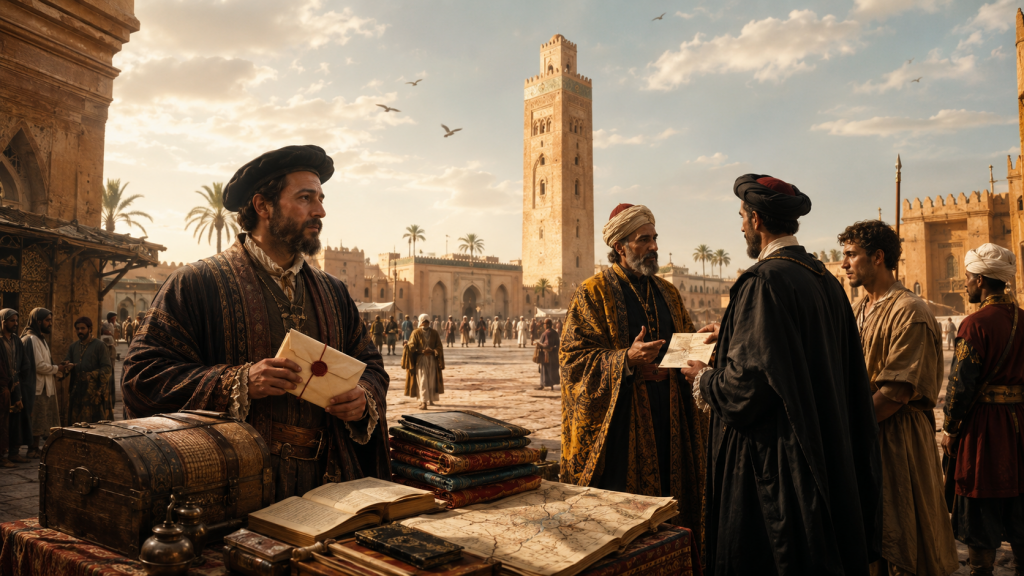
Merchants, ransomers of captives and political informants, the Marchenas occupied, between the late sixteenth and early seventeenth centuries, the space left vacant by official embassies. Juan de Marchena dealt personally with Sultan Ahmad al-Mansur and sent reports from Marrakesh to the Duke of Medina Sidonia. The surviving documentation confirms the importance of this Sephardic family, although it does not yet allow us to state with certainty that they originated in the Sevillian town of Marchena.
The history of the Marchena family published by Marchena Secreta reconstructs the journey of a Sephardic Jewish family that preserved the surname De Marchena after leaving the Iberian Peninsula. The account is based on genealogical research carried out by their descendants, particularly Kenneth de Marchena, and on references to Sephardic communities in Portugal, Amsterdam and the Caribbean.
The importance of this new study on the Marchena family and the House of Medina Sidonia lies in the fact that it connects their activities in Spain between 1570 and 1620 and traces several Marchena brothers across Morocco, Portugal, Italy, Croatia, Germany and Amsterdam.
Abraham de Marchena, the Sephardic Jewish patriarch of the Marchena family who was buried at the synagogue in Amsterdam, had several brothers. The author of this research, Miguel Soto Garrido, will investigate the family’s presence in Venice, where they lived between 1590 and 1606 and became one of the most prominent families in the Sephardic ghetto.
The surname De Marchena is documented among Sephardic families established in Portugal and the Netherlands. Their descendants believe that the name preserves the memory of the place from which the lineage originally came, although no document has yet been found explicitly identifying the earliest known ancestor as a native of Marchena in Seville.
Marrakesh, 23 June 1600
A Jewish merchant takes up his pen to write to one of the most powerful men in Andalusia. The recipient is Alonso Pérez de Guzmán, 7th Duke of Medina Sidonia. The sender signs his name as Juan de Marchena.
He does not write only about goods, prices or ships. He informs the duke that Friar Constancio Magni, a Dominican religious, has been imprisoned by the Moroccan authorities for eight months. Marchena states that he has personally intervened: he had spoken “twice to the King”, meaning the Saadian sultan Ahmad al-Mansur, and had approached the kingdom’s judicial authorities on other occasions to request the friar’s release.
The letter places Juan de Marchena in an extraordinary position: a Jew who could approach the ruler of Morocco, negotiate with his officials and subsequently pass confidential information to the House of Medina Sidonia.
Source: General Archive of Simancas, State section, bundle 185, document 11, letter sent from Marrakesh on 23 June 1600.
An Agent Between Two Shores
Historians Miguel Soto Garrido and Miguel Ángel de Bunes Ibarra describe Juan de Marchena as a “crypto-Jewish double agent” serving the ducal House of Medina Sidonia in Marrakesh. He was a merchant, took part in the ransoming of captives and maintained a close relationship with Ahmad al-Mansur, Sultan of Morocco between 1578 and 1603.
At the same time, he regularly sent reports to the 7th Duke of Medina Sidonia, who, from the beginning of the 1580s, had become one of the main figures responsible for Moroccan affairs and for defending the interests of the Spanish Monarchy in the Strait of Gibraltar.
In that Mediterranean world of permeable frontiers, an agent could work for several patrons, protect his family’s businesses, serve the sultan in certain operations and provide information to the duke.
Diplomacy Without Ambassadors
Philip II and, later, Philip III avoided maintaining a permanent ambassador at the court of the Sultan of Morocco. Formally recognising a Muslim ruler and maintaining a stable diplomatic presence at his court created political, religious and reputational difficulties.
The embassy of Pedro Venegas de Córdoba, established in Marrakesh between 1579 and 1585, ended in troubled circumstances. According to the study by Soto Garrido and De Bunes, Venegas had to leave Morocco because maintaining an official representative at an Islamic court posed a danger to the reputation of the Spanish Monarchy.
That diplomatic vacuum did not bring relations to an end. It merely made them more discreet. Contacts were conducted through unofficial agents, merchants, religious figures, interpreters, governors of Spanish strongholds in North Africa and representatives of the great Andalusian noble houses.
Juan de Marchena prospered in this ambiguous environment. He could present himself as a merchant or a ransomer of captives, but his letters had an unmistakably diplomatic character. He reported on decisions taken at court, intervened with the authorities and even called for the Spanish king to send someone to protect Christian subjects living in Morocco or held there in captivity.
Marchena did not carry an ambassador’s credentials, but he performed part of the work of an embassy.
The Triangle Between Madrid, Portugal and Sanlúcar
To understand his importance, one must examine the political organisation created during the reign of Philip II. Miguel Soto Garrido has studied the formation of a kind of “Secretariat of Barbary”, built from 1574 onwards around the royal secretary Gabriel de Zayas.
Gabriel de Zayas was born in Écija, Seville, in 1526 and died in Madrid on 13 July 1593. He served Philip II as Secretary of State, Secretary of the Council of State and Secretary of the Council of Italy.
The Zayas lineage had been established in Andalusia, particularly in Écija and Córdoba, since the time of the Christian conquest. His brother, Tomás de Zayas, was the “overseer of the troops in Granada”. Gabriel de Zayas was also a cleric of the Diocese of Seville.
The system connected the Spanish court with advisers involved in Portuguese policy in North Africa and with the House of Medina Sidonia, based in Sanlúcar de Barrameda.
Portugal had directed much of the relationship with the Atlantic Maghreb for decades. However, the Moroccan civil war that began in 1574, Ottoman intervention and the Battle of Alcácer Quibir in 1578 changed the balance of power. The Spanish Monarchy needed to know what was happening on the other side of the Strait and to prevent the influence of Algiers and the Ottoman Empire from reaching Morocco.
Between 1581 and 1584, the Duke of Medina Sidonia began centralising in his palace in Sanlúcar the letters and reports arriving from Cádiz, Gibraltar, Ceuta and Tangier. The duke examined the information and forwarded it to the minister Gabriel de Zayas, from whom it could pass to other advisers and eventually to the king.
The reports sent by Juan de Marchena from Marrakesh formed part of this system. While Zayas organised the information at court and Medina Sidonia filtered it from Sanlúcar, Marchena provided what neither of them could obtain directly: news gathered from within the sultan’s own circle.
A Family, Not Merely One Individual
Miguel Soto Garrido has carried out research entitled:
“The Sephardic Marchena Family: Merchants and Diplomatic Agents Between Italy and the Maghreb, 1580–1605.”
The title is revealing. The phenomenon was not limited to Juan de Marchena but involved an entire family group with connections between Italy and North Africa. The Marchenas appear to have combined commerce, intelligence gathering and political representation for at least twenty-five years.
Related articles
American Jews Search for Their Roots in Marchena and Andalusia
Sephardic Families Who Left Marchena 500 Years Ago Search for Their Roots
The Routes by Which Sephardim Fled from Spain to Portugal
Abraham de Marchena and the Amsterdam Period
The central figure in the published genealogy is Abraham de Marchena, whom many descendants identify as their common ancestor in Amsterdam. From there, the family joined the commercial and family networks linking the Netherlands with the Caribbean colonies.
Abraham de Marchena is said to have been buried in Amsterdam in 1657.
These Sephardic families could have relatives, business partners and correspondents in several different ports. Their family network was also a communications network. Goods travelled accompanied by letters; ransom operations provided access to rulers; and commercial journeys offered opportunities to gather information about alliances, wars, epidemics and the movement of ships.
Jews at the Heart of the Moroccan Administration
The presence of Jewish intermediaries was not exceptional in Saadian Morocco. The study by Soto Garrido and De Bunes explains that some Jewish families held important positions as advisers, secretaries and interpreters to the sultans.
Their knowledge of languages and their membership of international commercial networks made these men particularly valuable. They could translate letters, accompany embassies, negotiate with Christian powers and facilitate exchanges between societies divided by profound religious differences.
These merchants understood the codes of several different societies. They could speak to a Muslim official in Marrakesh, negotiate with a Christian nobleman in Sanlúcar and call upon relatives or business associates established in Italian cities. The diaspora, born from persecution and expulsion, also became an international network of contacts.
Kenneth de Marchena’s Symbolic Return
In August 2018, Kenneth de Marchena, who was born in Curaçao and lived in the Netherlands, travelled to Marchena to visit the town that he and his family associated with the origin of their surname. Marchena Secreta presented the visit as the first publicly documented return of a Sephardic De Marchena descendant interested in researching and sharing the history of his roots.
Kenneth had spent years reconstructing the family tree together with relatives living across Europe and the Americas. He was also working on a book about the origin and spread of the surname. His visit transferred a study conducted mainly online and through family archives into the physical setting of the Sevillian town itself.
Sources Consulted
The principal source is the article by Miguel Soto Garrido and Miguel Ángel de Bunes Ibarra, “Religious Propaganda, Devotional Zeal and Christian Diplomacy: The Missions of the Province of San Diego of Andalusia in the Light of the Misión Historial de Marruecos,” published in Archivo Ibero-Americano, volume 83, number 297, 2023, pages 567–609. The article directly cites Juan de Marchena’s letter preserved in the General Archive of Simancas.
The political context comes from Miguel Soto Garrido’s study “Gabriel de Zayas, ‘Secretary of Barbary’: The Formation of a New Territorial Negotiation in the Monarchy of Philip II,” which analyses the network connecting the royal court, Portuguese advisers and the House of Medina Sidonia.
The existence of research specifically devoted to the family is confirmed by the official programme of the international conference held at the Collège d’Espagne in Paris in 2023, which included the paper “The Sephardic Marchena Family: Merchants and Diplomatic Agents Between Italy and the Maghreb, 1580–1605.”